

Center-Set Church
What does centered-set mean?
To understand what a centered-set church is, it helps to first explore two other types of ways to feel belonging in a church community setting. Let’s look into what that looks like to see how a centered-set differs and why it is important here at Christ Church.
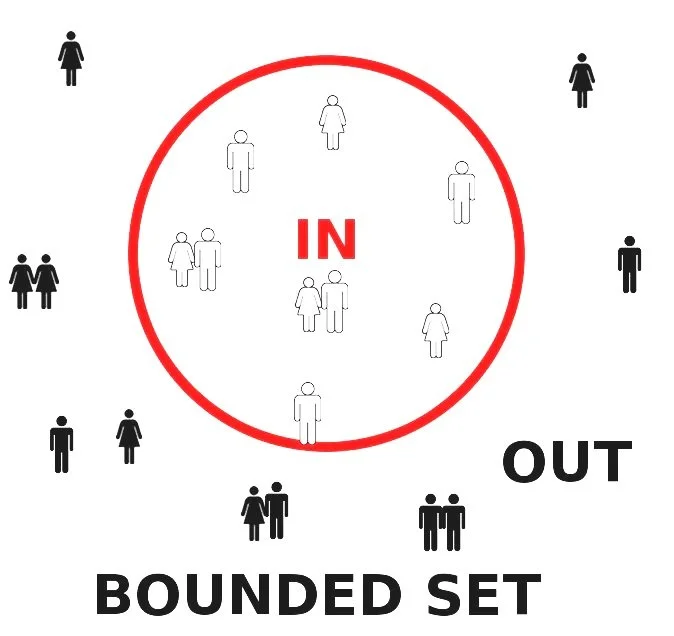
Bound-Set.
In a bounded set, belonging is determined by where one stands in relation to a clear boundary. Typically, the boundary is composed of highly defined beliefs and behaviors. Those who adopt the beliefs and behaviors are considered "inside" and those who do not are considered "outside."
For example, in bounded-set churches, certain appearances or behaviors can exclude you from the community. If you have tattoos, piercings, or dyed hair — if you are going through divorce or trying to survive as a single parent — if you struggle with addiction or suffer from past abuse — you might feel judged or scorned by these communities and see yourself as an outsider. You may also notice that being "inside" the community is defined more by conformity to these defined behaviors and beliefs, rather than acting like Christ.

Fuzzy-Set.
In a fuzzy set, belonging is not determined by clear boundaries or by clear movement toward a center. Instead, the lines between who belongs and who does not belong are often vague or almost nonexistent. These communities may be very open, welcoming, and easy to enter, but they can lack a clear understanding of membership, commitment, accountability, and discipleship.
A fuzzy-set church is similar to a group of people playing pickup basketball at a public park. There may be a regular group that shows up most weekends, and if someone new wants to play, they are usually welcomed in. But there is no real membership, no defined team, no coach, no practices, and no expectation that the same people will keep showing up. The group exists because people have a shared interest and happen to be present.
In the same way, fuzzy-set churches may avoid the judgmentalism of bounded-set communities, but they can also lose a clear call to follow Jesus together. People may attend, participate, and feel connected, but still not know what belonging to the church actually means. While the church should be open and welcoming to those who are searching, struggling, or wounded, it should also clearly call people to Christ, to transformation, and to life together as His people.
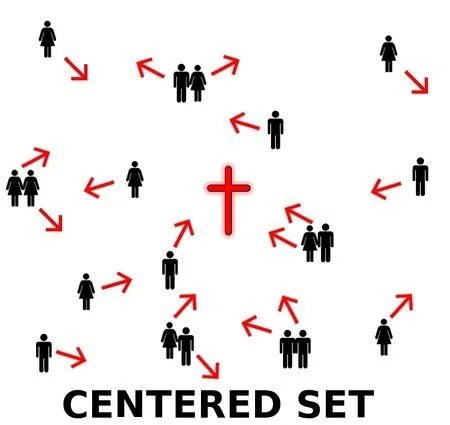
Centered-Set.
With a "centered-set" approach, participation in the community is defined differently. The center is Jesus and there is no boundary determined by an expected set of behaviors or beliefs. Those who are "in" are considered so simply because they are moving towards Christ.
In a centered-set approach, a person might be quite a distance from the center, but as long as they are looking to and moving towards Christ, they belong in the community. By the same token, a person might appear close to the center, but if they are not looking to or moving towards Christ, loving correction may be needed.
Many of us have crossed paths with avid believers who adhere more to a set of "rules" of religion, rather than trying to authentically live like Christ, who held the company of sinners and challenged the religious leaders of his day. In a centered set, believers who take comfort in conforming their behavior to an accepted set of norms while keeping their hearts cold and distant from God do not belong. "Looking the part" does not make someone belong here; instead, a desire to follow after Christ and to see real heart transformation marks those who belong in our community.
Why We Embrace A Centered-Set Approach
Each approach has advantages and disadvantages. We believe the advantages of the centered-set approach outweigh the disadvantages, and that this approach fits our vision to reach those who don't often find a home in other church communities.
The centered-set approach is like gathering cats rather than herding cattle — the center is the pail of milk that draws the cats. It emphasizes the power of Jesus to attract us and transform our hearts in his time.
The centered-set approach is in keeping with the biblical metaphor of pilgrimage. The followers of Jesus are travelers coming from many different points of origin to a common destination.
It does not undermine or water down biblical truth, but it does place an emphasis on following Christ's model of compassion and gentleness.